
On arrival at Cork:
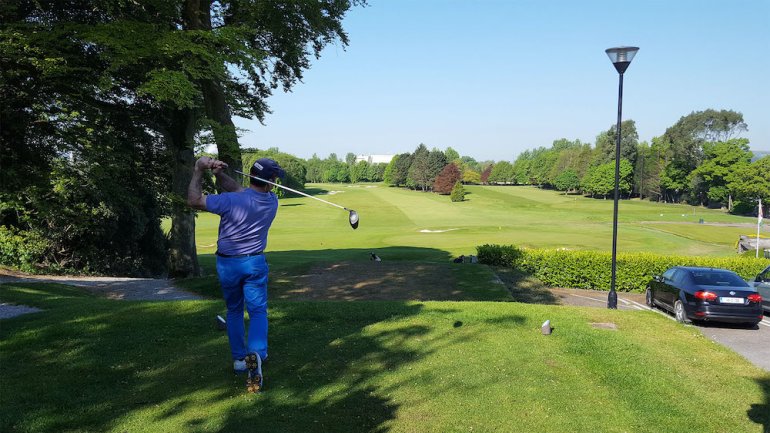
The carpark is a rectangular space and golfers may find more room to park to the left side of the carpark. Once parked up, follow the pathway to the right of the clubhouse and to check-in, the putting green, the 1st Tee, and the Pro-shop.
Certainly, the first point of call is to visit the Pro-Shop for immediate advice and to deal with questions that you may have. Mr Peter Hickey PGA is the Club professional at Cork Golf Club. Certainly, the Pro-Shop equipped with a range of wonderful golf shop items, and why not take a 30-minute tune-up before you play the game? I found that a quick 30-minute lesson with the PGA Pro is a good way to check that your golf swing is ready for action!
The Clubhouse & Facilities
To the left of the putting green, you enter the Clubhouse which still retains an old look and feel. Even the staircase creeks walking up to the bar or restaurant. The locker rooms for both ladies and gents are located on the ground floor and patrons can securely leave their belonging in the lockers under lock and key. Also, it’s worth noting that the bathrooms are spacious for use before or after golf.
The restaurant and bar are located on the 2nd floor and, I would recommend booking one of the nice clubhouse tables overlooking the 14th hole. Don’t miss out on viewing the long hallway leading to the second-floor exit which is packed with old Cork Golf Club memories of golfing legends.
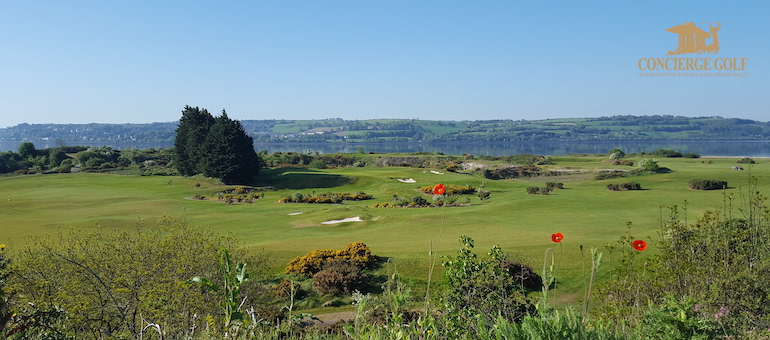
The practice ground is surrounded by the 1st hole and 15th and 16th Holes. But, do take care of golfers playing the course as you walk to the practice ground to hit a few balls to warm up. There may well not be any golfers playing, but it is good to be aware of what is happening around you.
Cluster the Holes, The Course Strategy
If I may cluster holes into a couple of categories to describe the challenges at Cork. The first cluster are golf holes that require the golfer to play a series of good shots to hit the green for a chance of a birdie or a solid par. Cluster two are the tricky holes that will require your close attention. The third cluster are holes that are green light holes to shoot for the flag and make birdies.
Cluster 1:
The holes 4th, 5th, 7th, 8th,9th, 10th, 15th, 17th & 18th. Each of the holes mentioned requires good tee shots at a minimum and good approach shots to the par 4s and par 5s.
Cluster 2:
Golf holes 1st, 12th, 13th, 14th – each of the holes are tricky and there is nothing wrong with playing for the centre of the green and taking par where possible.
Cluster 3:
Golf Holes such as the 2nd, 3rd, 6th, 11th, 16th are the easiest holes on the course to try and pick up birdies.
Especially the clustering of holes is a strategic method to decipher for playing the course about what holes to go for birdies and what holes to take par.
My favourite tee shot is at the 4th hole and a good tee shot to the right side of the fairway is needed for the best opportunity to attack the flag. Also, excellent tee shots are required to hit each of the par 3s. Whereas, if you are unlucky to miss any of the pars 3s, you are left with a hard chip shot to get up and down.
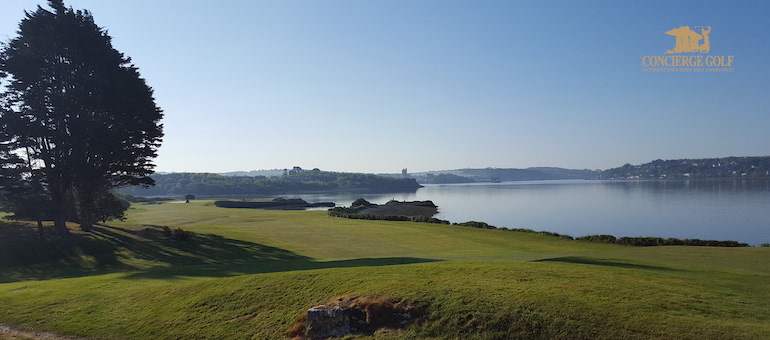
One of the nice parts about Cork G.C is that the grass around the greens is a light fescue grass which is easy to chip through. The bunker sand is good quality sand and relatively easy to play out of the bunkers (depending on the lie of course!). But it is best to avoid bunkers where possible. Finally, the views of the River Lee from the tee boxes on 4, 5, 6, 7, 8, 9, 10 & 11 are quite picturesque.
More Course Insights:
The stretch of holes that run through the old limestone quarry from the 4th to the 10th and golfer need to conquer the quarry holes to post a good score. Also, the golfer that shapes the ball both ways will be another scoring advantage. Such as the 1st, 2nd, 3rd, 8th, 10th, 11th, 15th, 17th suit a draw tee shot and holes 4th, 5th, 12th, 14th, & 18th suit a fade tee shot. Indeed, the par 3s can be played either way depending on the flag location.
The Golf Course at Cork
There is a lot of very interesting history of the Club worth investigating. The Club started as a 9-hole Golf Club in 1888. A number of years later, the famous Dr Alister MacKenzie who was also working on redesigning Lahinch Golf Club also redesigned Cork G.C in 1926.
In 1932 the Irish Open Tournament was played at Cork G.C and at that time the championship course measured 6,731 yards. In later years, the most famous club golfers to have played under the club’s banner was Jimmy Buren. Buren’s major achievement was winning the British Amateur Championship in 1946 and in 2019 another fellow Corkman won the British Amateur Open at Portmarnock Golf Club.
The Course length | Cork Golf Club Review
The ladies course is par 74 and the men’s course is typically par 72.
- Red tee: 5672 yards
- Green tee: 6239 yards
- White/Medal tee: 6533 yards
- Blue tee: 6813 yards
Indeed, golfers can maximize their enjoyment by playing a course length that suits their game. We all know that playing a golf course that is too long or too short will not test the golfer’s ability. Mainly, from my PGA experience, I find that golfers hit tee shots that carries between 190 – 240 yards would enjoy a good challenge playing from the White/Medal Tees. The Blue Tee would suit golfers that carries the ball over 240 yards. Whereas, golfers would enjoy the Green Tee that carry the ball 150 – 190 yards. Finally, golfers should play from the Red Tees for tee shots hit less than 150 yards.
My advice to golfers playing Cork for the first time is that there are a couple of keys to playing well to score. Initially, like a lot of golf courses, a good position from tee shots is important. Manage your second shots to favour playing for short of the flag rather than playing too much club because there is trouble over the back of most greens. In fact, there is deep trouble behind 15 out of 18 greens, if you are longer by more than 10 yards.